



Private Markets in a Higher Interest Rate Environment
Renewed inflation and a shift back toward higher interest rates are bringing financing costs, valuations and liquidity back into focus across private markets. Their effects vary by strategy, depending on cash-flow resilience, financing structures, valuation methods and pricing power.
Based on AltamarCAM’s portfolio experience, we examine the implications for private equity, venture capital, private credit, infrastructure and real estate, and the opportunities that uncertainty can create for disciplined investors.
Renewed inflationary pressures following the conflict in Iran have prompted the Federal Reserve and European Central Bank to shift back toward higher interest rates. Disruptions through the Strait of Hormuz have kept energy costs elevated.
Policy rates were still around 150 basis points below their 2023 peaks, but US 10-year Treasury and German Bund yields had reached their highest levels since 2007 and 2009, respectively. Long-term financing conditions had therefore already tightened before the recent policy moves.1
Financing costs and liquidity come into focus
For transaction activity, we believe the change in the direction of rates can make buyers more cautious while sellers take longer to adjust price expectations, slowing investment and exits. Delayed distributions can also constrain investors’ capacity to commit capital and weigh on fundraising.
Valuations may face pressure and holding periods may lengthen, increasing the importance of earnings growth and operational value creation. The industry focus on experienced managers and businesses not correlated to GDP should help moderate these effects, although target returns may take longer to achieve.
Increasing interest rates could translate into a broader macroeconomic impact. Exposure varies by business model: businesses providing essential products and services, as well as those with pricing power, may be better placed to defend against weaker demand. On the other hand, periods of uncertainty can also create attractive entry opportunities for disciplined investors with available capital.
Different effects across strategies
Private equity. The industry has successfully navigated higher-rate environments, including throughout the 1980s and 1990s, the years preceding the Global Financial Crisis, and during the 2022-24 tightening cycle, activity slowed but the industry continued to deliver attractive returns.
Median IRR by Vintage Year in Europe & North America (1995 – 2023)
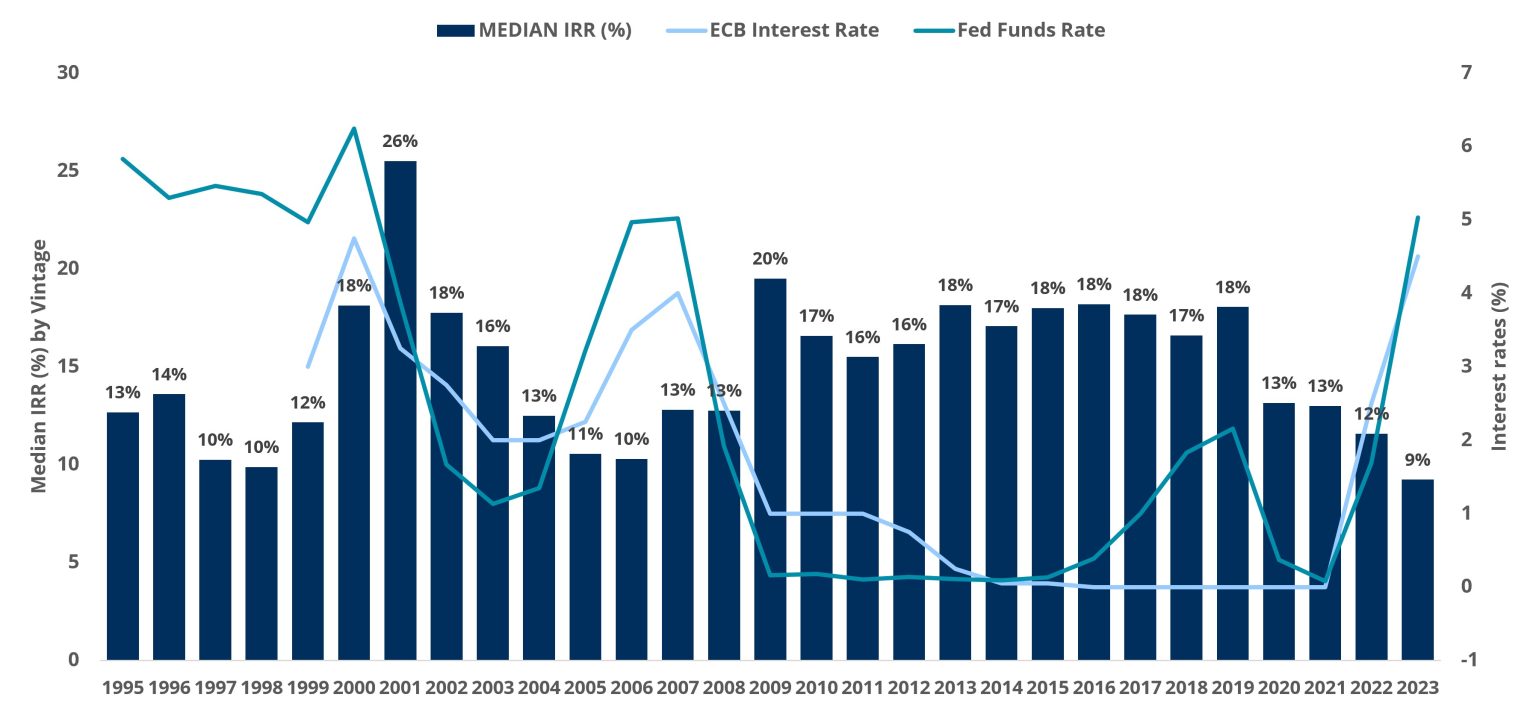
Source: Preqin – Data obtained from Preqin Pro. Sample contains the following PE strategy: buyouts. Vintage: from 1995 to 2025. Geographical focus: Western Europe + UK + NA (Canadá and USl. Data as of March, 2026.
Note: Past returns are not necessarily indicative of future results given that the current economic conditions are not comparable to prior conditions, which may not repeat in the future. There are no guarantees that the funds will have similar results as previous funds
As an example, during the 2022-24 period, characterized by increasing interest rates driven by the inflation spike, AltamarCAM’s PE portfolio delivered an 11% EBITDA CAGR while maintaining a 19% EBITDA margin2. Returns depend increasingly on earnings growth and operational improvement, with less scope for multiple expansion. Businesses with resilient demand, limited capital intensity and manageable leverage are the ones that should navigate better this period. A well-set portfolio construction alongside experienced managers across those cycles and with diversification across vintages, sectors and regions is also important.
Venture capital. Most VC-backed technology companies carry little or no debt. The greater sensitivity is to discount rates, which could affect valuations, equity financing and exit conditions, particularly for long-duration growth businesses. IPO and M&A activity may also be constrained, although AI creates important distinctions within the portfolio: Strong demand for these companies may also support funding, valuations and exits, while businesses without these tailwinds remain more exposed. More selective fundraising conditions may favour established managers.
Private credit. For direct lending, higher base rates increase floating-rate coupons but also weaken borrowers’ interest coverage and free cash flow. Higher income therefore needs to be assessed alongside credit quality and potential losses. New loans may offer higher yields and spreads, better original issue discounts, lower leverage and stronger documentation as competition becomes more selective and the opportunity set for lenders may also improve as borrowers become more accepting of lender-friendly terms. The main near-term constraint is likely to be deployment, as uncertainty and higher financing costs can reduce transaction volumes and slow origination. Higher financing costs and refinancing pressure may also expand opportunities in distressed debt and special situations, including rescue financing, discounted debt purchases and restructurings. Amendments and extensions can delay defaults, so stress may emerge gradually.
Infrastructure. Infrastructure’s long-duration cash flows and substantial upfront investment create sensitivity to discount rates and financing costs. Inflation-linked revenues and long-term fixed or hedged debt can provide meaningful protection. As an example, approximately 70% of the NAV of AltamarCAM’s infrastructure portfolio has fixed or hedged financing; separately, approximately 70% has revenues directly linked to inflation. During 2022-24, the portfolio delivered c.11% EBITDA CAGR while maintaining a c.39% EBITDA margin3. Pass-through depends on contractual terms and the timing of tariff resets on regulated assets, while assets exposed to demand risk depend more on essentiality and users’ willingness to absorb price increases. Higher debt service can still absorb indexed income gains. Selective buyers with available capital may benefit from repricing.
Real estate. The industry faces renewed tightening after the substantial 2022-24 repricing, with valuations remaining below previous peaks. This lower starting point differs from that of 2022 but does not prevent further cap-rate expansion or valuation pressure. CPI-linked leases, lease renewals and new leases at market rents can support net operating income and partly offset higher debt costs, depending on occupancy and sector fundamentals. Industrial, data center and residential assets benefit from stronger structural demand drivers than more challenged office and retail segments. As an example, AltamarCAM portfolio has pivoted its exposure to sectors supported by long-term megatrends from 37% of NAV in our third program (committed between 2013 and 2018) to over 79% in the latest fund (committed between 2021 and 20264). We believe this shift supports stronger income growth prospects and should help moderate valuation pressure in the current environment. A heavier debt burden can reduce distributable cash and delay exits. Transaction activity, which has already recovered more slowly than expected, may therefore remain uneven as buyers and sellers adjust to the higher-rate environment.
Our investment approach
We remain constructive on private markets over the long term, while recognizing that the coming quarters may experience certain valuation pressure in some sectors. A key priority is to maintain investment discipline in terms of entry prices, careful assessment of financing and cash generation, and focus on managers with proven capabilities across cycles.
We continue to deploy selectively through primaries, secondaries and co-investments, while maintaining diversification across vintages, regions and strategies. Periods of uncertainty can offer attractive entry opportunities, but investment terms must compensate for risk.
Sources
- AltamarCAM Views on the Current Interest Rate Environment. Market data as of 30 September 2026 unless otherwise stated; sources cited in that note include Investing.com, the Federal Reserve and the European Central Bank.
- AltamarCAM internal data covering more than 1,100 underlying companies across PE primaries, secondaries and co-investments in North America and Europe. Portfolio data as of 31 December 2025; EBITDA growth and margin figures refer to 2022-24. AltamarCAM’s FoFs: Altamar V – Private Equity Program 2010, FCR, de Régimen Simplificado (ACP PE 3), Altamar VI Emerging Markets Private Equity, FCR (ACP PE 4), Altamar Global Private Equity Program VIII, FCR (ACP PE 5), Altamar X Global Private Equity Program, FCR (ACP PE 6), Altamar X – Global Buyout Midmarket US$, FCR (ACP PE 6 MM), ACP PE 7, ACP PE 7 LMM, Altamar Secondary Opportunities VII, FCR (ACPS 2), Altamar Global Secondaries IX, FCR (ACPS 3), ACP S4, ACPS 5 y ACP PE Co-Investments I. Note: Past returns are not necessarily indicative of future results given that the current economic conditions are not comparable to prior conditions, which may not repeat in the future. There are no guarantees that the funds will have similar results as previous funds.
- AltamarCAM infrastructure team analysis, including performance evolution of Altamar Infrastructure Income I, Altamar Infrastructure Income II and ACP Infrastructure Income III. EBITDA growth and margin figures refer to 2022-24. Note: Past returns are not necessarily indicative of future results given that the current economic conditions are not comparable to prior conditions, which may not repeat in the future. There are no guarantees that the funds will have similar results as previous funds.
- AltamarCAM real estate team analysis. Megatrend sectors include residential, data centers, PBSA, BTR, healthcare, senior living, hotels and others. Data corresponding to total NAV of underlying investments as of Q4 2025. Altan III (vintage 2013) is the third commingled fund, while Altan V (vintage 2021) is the last commingled fund invested.
IMPORTANT NOTICE:
This document contains information subject to change regarding Altamar CAM Partners, S.L., Altamar Private Equity, SGIIC SAU, CAM Alternatives GmbH and their subsidiary and affiliated companies (collectively referred to as “AltamarCAM”), as well as other funds and vehicles actively managed or advised by AltamarCAM (the “Funds”). It has been prepared for informational and illustrative purposes, as a general market commentary, and is provided for the exclusive use of its intended recipient. If you did not receive this document directly from AltamarCAM, you should not read, use, copy, or share it.
The information contained in this document reflects, as of the date of publication, AltamarCAM’s views, which may change at any time without prior notice. AltamarCAM is under no obligation to update it or to provide any potential updates.
This document is based on sources considered reliable and has been prepared with the utmost care to avoid being unclear, ambiguous, or misleading. However, no representation or warranty is made regarding its truthfulness, accuracy, or completeness, and it should not be regarded as such. AltamarCAM assumes no responsibility for the information contained in this document.
This document may contain projections, expectations, estimates, opinions, or subjective judgments, all of which must be interpreted as such and never as a statement or guarantee of present or future results, performance, or returns. To the extent that this document contains statements about future performance, such statements are forward‑looking and subject to a number of risks and uncertainties. Past performance is not necessarily indicative of future results, as current economic conditions are not comparable to those that existed previously and may not repeat in the future. There is no guarantee that the Funds will achieve results comparable to previous funds. Nor are there guarantees regarding specific returns, asset diversification, the materialization of assumptions (regarding the market, its stability, its risks, or any other matter), or the fulfillment of any particular strategy, approach, or investment objective. All of the foregoing will depend, among other factors, on the operating performance of the Funds’ portfolio companies, asset values and market conditions at the time of sale, transaction-related costs, and the timing and method of exit—all of which may differ from the assumptions used in the data contained herein. Consequently, returns are not guaranteed: product values are subject to market fluctuations, these forecasts do not represent a reliable indicator of future results, and such returns may be zero or even negative. Investors should bear in mind that any returns generated are subject to taxation, which will depend on each investor’s individual circumstances and may change in the future.
This document is solely a general market commentary and should not be interpreted as regulated advice, an investment offer, a solicitation, or a recommendation. Alternative investments may be highly illiquid, speculative, and may not be suitable for all investors. Investment in alternative assets is intended only for experienced and sophisticated investors who are willing to assume the significant economic risks associated with such investments. Prospective investors in any alternative investment should consult the specific legal documentation of the relevant vehicle, where they will find the specific risks and considerations associated with that particular alternative investment. Investors should carefully review and consider potential risks before investing. No person or entity receiving this document should make an investment decision without obtaining prior and individualized legal, tax, and financial advice.
Neither AltamarCAM nor any of its group companies, nor their respective shareholders, directors, managers, employees, or advisors assume any responsibility for the integrity or accuracy of the information contained herein, nor for any decisions made by recipients of this document based on it or on the information it contains.
This document is strictly confidential and may not be reproduced or disclosed in any manner, in whole or in part, without the prior written consent of AltamarCAM.